About The Nitrogen Cycle?
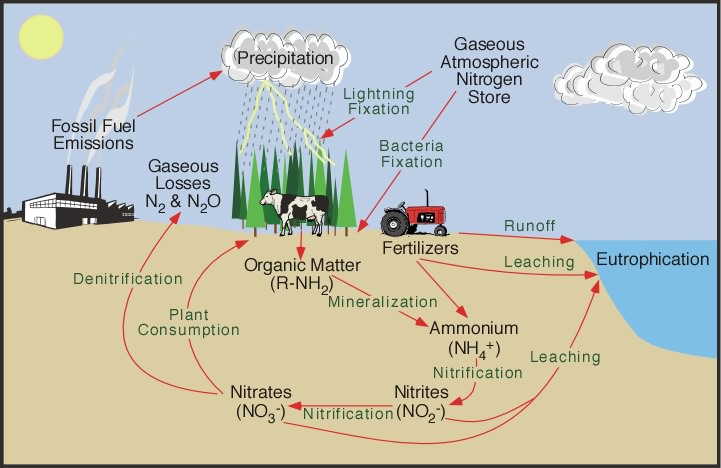
The Nitrogen Cycle includes important process like fixation, mineralization, nitrification and denitrification. In the Earth's atmosphere, it is approximately 78% of Nitrogen making it the largest pool of nitrogen. But, the atmospheric nitrogen has limited availability for biological useage, leading to a lack of usable nitrogen in many types of ecosystems.
 Why is the cycle important?
The Nitrogen Cycle is important because it goes into the soil which produces nutrients for the plants that give us food to eat. Also it is because it continuously goes around, never runs out and its re-useable. If the cycle doesn't continuusly goes around it will greatly affect both the environment, humans and even animals. This links up to Sustainability because it helps the environment and us by producing nutrients to the soil which then goes to the plants.
Nitrogen Cycle processes
1. Nitrogen Fixation
Nitrogen is the most abundant element in our atmosphere. It is a vital element as many classes of compounds essential to living systems are nitrogen-containing compounds. Nitrogen is a primary nutrient for all green plants, but it must be modified before it can be readily utilized by most living systems. Nitrogen fixation is one process by which molecular nitrogen is reduced to form ammonia. This complex process is carried out by nitrogen-fixing bacteria present in the soil. Although nitrogen-fixation involves a number of oxidation-reduction reactions that occur sequentially, that reaction which describes its reduction can be written in a simplified way as:
N2 + 6 e- + 8H+ ---> 2 NH4+ (ammonium ion)The ammonium ion (the conjugate acid of ammonia, NH3 ) that is produced by this reaction is the form of nitrogen that is used by living systems in the synthesis of many bio-organic compounds.
Another way by which ammonia may be formed is by the process called nitrification. In this process compounds called nitrates and nitrites, released by decaying organic matter are converted to ammonium ions by nitrifying bacteria present in the soil. The process carried out by these bacteria is also a complex series of oxidation-reduction reactions. The reduction reactions involving nitrate and nitrite ions can be simplified as:
      NO3-     +  2e-  +  2H+  ----------->   NO2-        +  H2O
 (nitrate ion)                          (nitrite ion)


      NO2-     +  6e-  +  2H+  ---------->    NH4+        +  2 H2O
Another way in which molecular nitrogen is modified is via the discharge of lightning. The tremendous energy released by the electrical discharges in our atmosphere breaks the rather strong bonds between nitrogen atoms, causing them to react with oxygen. Note in this process, nitrogen is oxidized and oxygen is reduced. lightning
N2 + O2 --------------> 2 NO (nitric oxide)
The nitrous oxide formed combines with oxygen to form nitrogen dioxide.2 NO + O2 ---------------> 2NO2Nitrogen dioxide readily dissolves in water to product nitric and nitrous acids;
2 NO2 + H2O -------> HNO3 + HNO2These acids readily release the hydrogen forming nitrate and nitrite ions which can be readily utilized by plants and micro-organisms.
    HNO3   -------->   H+  +  NO3-  (nitrate ions)
    HNO2   -------->   H+  +  NO2-  (nitrite ions)
Denitrifying bacteria, act on ammonia as well as nitrates produced by death and decay, recycling these compounds as free nitrogen (N2). The nitrogen that is fixed by the processes described above is eventually returned to the atmosphere by this denitrification process, to complete what is commonly referred to as the "nitrogen cycle".
A Summary of Nitrogen Cycle
The nitrogen cycle is the process by which nitrogen is converted between its various chemical forms. This transformation can be carried out by both biological and non-biological processes. Important processes in the nitrogen cycle include fixation, mineralization, nitrification, and denitrification. The majority of Earth's atmosphere (approximately 78%) is nitrogen, making it the largest pool of nitrogen. However, atmospheric nitrogen has limited availability for biological use, leading to a scarcity of usable nitrogen in many types of ecosystems. The nitrogen cycle is of particular interest to ecologists because nitrogen availability can affect the rate of key ecosystem processes, including primary production and decomposition. Human activities such as fossil fuel combustion, use of artificial nitrogen fertilizers, and release of nitrogen in wastewater have dramatically altered the global nitrogen cycle

